


Page 23 - Innovator's Science-8
P. 23
this, they also release oxygen and produce more than half of the Earth's
                                     oxygen supply. They are rich in nutrients and serve as a food source for

                                     many aquatic animals. Some, like Spirulina, Chlorella, and Diatoms, are also
                                     used by humans as health supplements and medicines. Microalgae also
                                     help in cleaning water and are used to make biofuel. However, pollution,
                                     climate  change,  and  habitat  destruction  are  threatening  microalgal

                                     diversity and abundance. It is important to conserve these tiny organisms
                                     to protect the environment and maintain oxygen balance on Earth.

                                     You have now learned about microorganisms and how they play many roles
                                     on Earth. Let us now understand the smallest unit that makes up every
                                     living thing.

                                     Want to Grow Spirulina? Here's How!
                 Science             Growing Spirulina is simple and can even be a source of income.
                     Bytes


                           Testimony  Follow these steps:
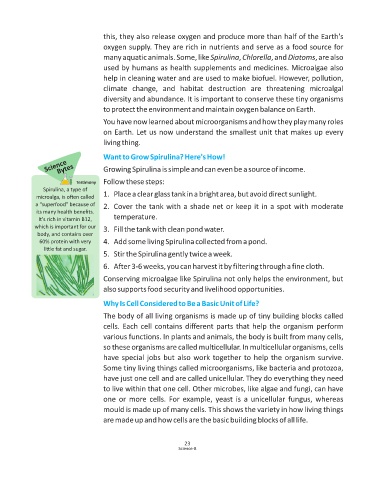
                Spirulina, a type of
              microalga, is o en called   1.  Place a clear glass tank in a bright area, but avoid direct sunlight.
             a “superfood” because of   2.  Cover the tank with a shade net or keep it in a spot with moderate
              its many health benefits.
              It's rich in vitamin B12,   temperature.
             which is important for our   3.  Fill the tank with clean pond water.
              body, and contains over
               60% protein with very   4.  Add some living Spirulina collected from a pond.
                li le fat and sugar.
                                     5.  Stir the Spirulina gently twice a week.

                                     6.  After 3-6 weeks, you can harvest it by filtering through a fine cloth.
                                     Conserving microalgae like Spirulina not only helps the environment, but

                                     also supports food security and livelihood opportunities.

                                     Why Is Cell Considered to Be a Basic Unit of Life?
                                     The body of all living organisms is made up of tiny building blocks called

                                     cells. Each cell contains different parts that help the organism perform
                                     various functions. In plants and animals, the body is built from many cells,
                                     so these organisms are called multicellular. In multicellular organisms, cells
                                     have special jobs but also work together to help the organism survive.
                                     Some tiny living things called microorganisms, like bacteria and protozoa,

                                     have just one cell and are called unicellular. They do everything they need
                                     to live within that one cell. Other microbes, like algae and fungi, can have
                                     one or more cells. For example, yeast is a unicellular fungus, whereas

                                     mould is made up of many cells. This shows the variety in how living things
                                     are made up and how cells are the basic building blocks of all life.


                                                                 23
                                                               Science-8

