


Page 24 - Innovator's Science-8
P. 24
Like  animal  and  plant  cells,  the  cells  of                Nucleoid
                 Science             microorganisms  are  surrounded  by  a  cell
                     Bytes
                                     membrane. Fungi cells also have a cell wall but
                           Testimony
              An electron microscope   lack chloroplasts, so they cannot make their own
              was first built in 1931 by   food  through  photosynthesis.  Bacteria  are
              German scien sts Ernst   different  because  they  do  not  have  a  well-
              Ruska and Max Knoll. It
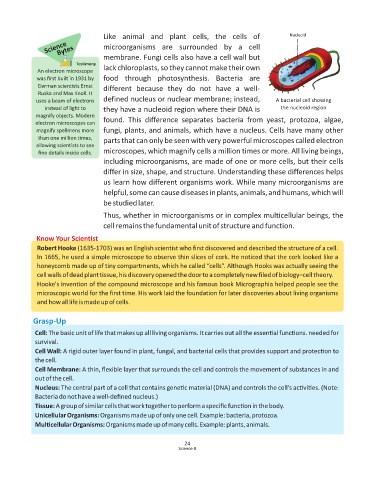
              uses a beam of electrons   defined nucleus or nuclear membrane; instead,          A bacterial cell showing
                instead of light to   they have a nucleoid region where their DNA is              the nucleoid region
             magnify objects. Modern
             electron microscopes can   found.  This  difference  separates  bacteria  from  yeast,  protozoa,  algae,
              magnify spellmens more   fungi, plants, and animals, which have a nucleus. Cells have many other
              than one million  mes,   parts that can only be seen with very powerful microscopes called electron
              allowing scien sts to see
              fine details inside cells.  microscopes, which magnify cells a million times or more. All living beings,
                                     including microorganisms, are made of one or more cells, but their cells
                                     differ in size, shape, and structure. Understanding these differences helps
                                     us learn how different organisms work. While many microorganisms are

                                     helpful, some can cause diseases in plants, animals, and humans, which will
                                     be studied later.

                                     Thus, whether in microorganisms or in complex multicellular beings, the
                                     cell remains the fundamental unit of structure and function.

              Know Your Scientist
              Robert Hooke (1635-1703) was an English scientist who first discovered and described the structure of a cell.
              In 1665, he used a simple microscope to observe thin slices of cork. He noticed that the cork looked like a
              honeycomb made up of tiny compartments, which he called “cells”. Although Hooks was actually seeing the
              cell walls of dead plant tissue, his discovery opened the door to a completely new filed of biology–cell theory.
              Hooke's invention of the compound microscope and his famous book Micrographia helped people see the
              microscopic world for the first time. His work laid the foundation for later discoveries about living organisms
              and how all life is made up of cells.


            Grasp-Up

             Cell: The basic unit of life that makes up all living organisms. It carries out all the essen al func ons. needed for
             survival.
             Cell Wall: A rigid outer layer found in plant, fungal, and bacterial cells that provides support and protec on to
             the cell.
             Cell Membrane: A thin, flexible layer that surrounds the cell and controls the movement of substances in and
             out of the cell.
             Nucleus: The central part of a cell that contains gene c material (DNA) and controls the cell's ac vi es. (Note:
             Bacteria do not have a well-defined nucleus.)
             Tissue: A group of similar cells that work together to perform a specific func on in the body.
             Unicellular Organisms: Organisms made up of only one cell. Example: bacteria, protozoa.
             Mul cellular Organisms: Organisms made up of many cells. Example: plants, animals.


                                                                 24
                                                               Science-8

