


Page 25 - Innovator's Science-8
P. 25
Points to Reflect

             •  Microorganisms are tiny living organisms that cannot be seen with the unaided eye. They are found in all
                 types of environments-even inside the bodies of plants and animals.
             •  Microorganisms can be either unicellular (made up of one cell) or multicellular (made up of many cells).
             •  The cell is the basic unit of life. All living things are made up of cells.
             •  A typical cell is surrounded by a cell membrane, filled with cytoplasm, and contains a nucleus. In addition,
                 plant, fungal, and bacterial cells have an extra layer called the cell wall.
             •  Unlike other cells, bacteria do not have a clearly defined nucleus.
             •  Cells vary in shape and size, and their shape is often related to the function they perform


                                                   NCERT Textbook Questions (Solved)

            Let Us Enhance Our Learning


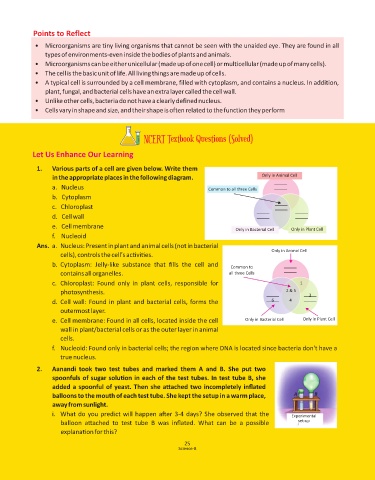
              1.   Various parts of a cell are given below. Write them
                   in the appropriate places in the following diagram.                      Only in Animal Cell
                   a.   Nucleus                                          Common to all three Cells
                   b.   Cytoplasm
                   c.   Chloroplast
                   d.   Cell wall
                   e.   Cell membrane
                                                                                  Only in Bacterial Cell  Only in Plant Cell
                   f.    Nucleoid
              Ans.  a.  Nucleus: Present in plant and animal cells (not in bacterial
                                                                                               Only in Animal Cell
                      cells), controls the cell's ac vi es.
                   b.  Cytoplasm:  Jelly-like  substance  that  fills  the  cell  and   Common to
                      contains all organelles.                                  all three Cells
                   c.  Chloroplast:  Found  only  in  plant  cells,  responsible  for                    1
                      photosynthesis.                                                               2 & 5
                                                                                                            3
                   d.  Cell wall: Found in plant and bacterial cells, forms the                6     4
                      outermost layer.
                   e.  Cell membrane: Found in all cells, located inside the cell     Only in Bacterial Cell  Only in Plant Cell
                      wall in plant/bacterial cells or as the outer layer in animal
                      cells.
                   f.  Nucleoid: Found only in bacterial cells; the region where DNA is located since bacteria don't have a
                      true nucleus.

              2.   Aanandi  took  two  test  tubes  and  marked  them  A  and  B.  She  put  two
                   spoonfuls of sugar solu on in each of the test tubes. In test tube B, she
                   added a spoonful of yeast. Then she a ached two incompletely inflated
                   balloons to the mouth of each test tube. She kept the setup in a warm place,
                   away from sunlight.
                   i.  What do you predict will happen a er 3-4 days? She observed that the           Experimental
                      balloon  a ached  to  test  tube  B  was  inflated.  What  can  be  a  possible    set-up
                      explana on for this?

                                                                 25
                                                               Science-8

