


Page 65 - Innovator's Science-8
P. 65
done with a spring balance or by comparing it with another object of
                                     known mass using a beam balance.  Since an object's weight is almost

                                     the same everywhere on Earth, we can use its weight to find its mass in
                                     most situations.
                                     Floating and Sinking

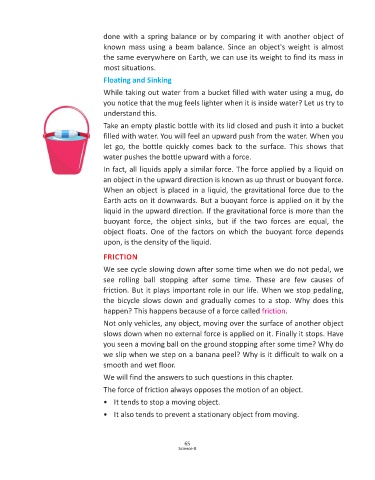
                                     While taking out water from a bucket filled with water using a mug, do
                                     you notice that the mug feels lighter when it is inside water? Let us try to

                                     understand this.
                                     Take an empty plastic bottle with its lid closed and push it into a bucket

                                     filled with water. You will feel an upward push from the water. When you
                                     let  go,  the  bottle  quickly  comes  back  to  the  surface.  This  shows  that
                                     water pushes the bottle upward with a force.

                                     In fact, all liquids apply a similar force. The force applied by a liquid on
                                     an object in the upward direction is known as up thrust or buoyant force.
                                     When an object is placed in a liquid, the gravitational force due to the
                                     Earth acts on it downwards. But a buoyant force is applied on it by the

                                     liquid in the upward direction. If the gravitational force is more than the
                                     buoyant  force,  the  object  sinks,  but  if  the  two  forces  are  equal,  the
                                     object  floats.  One  of  the  factors  on  which  the  buoyant  force  depends
                                     upon, is the density of the liquid.


                                     FRICTION
                                     We see cycle slowing down after some time when we do not pedal, we

                                     see  rolling  ball  stopping  after  some  time.  These  are  few  causes  of
                                     friction. But it plays important role in our life. When we stop pedaling,
                                     the bicycle slows down and gradually comes to a stop.  Why does this
                                     happen? This happens because of a force called friction        .

                                     Not only vehicles, any object, moving over the surface of another object
                                     slows down when no external force is applied on it. Finally it stops. Have
                                     you seen a moving ball on the ground stopping after some time? Why do

                                     we slip when we step on a banana peel? Why is it difficult to walk on a
                                     smooth and wet floor.

                                     We will find the answers to such questions in this chapter.
                                     The force of friction always opposes the motion of an object.

                                     •  It tends to stop a moving object.

                                     •  It also tends to prevent a stationary object from moving.


                                                                 65
                                                               Science-8

