


Page 68 - Innovator's Science-8
P. 68
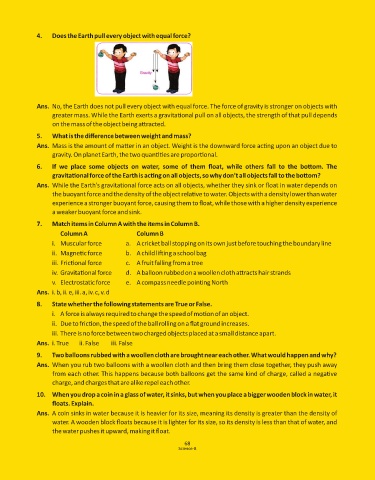
4.   Does the Earth pull every object with equal force?


              Ans.  No, the Earth does not pull every object with equal force. The force of gravity is stronger on objects with
                   greater mass. While the Earth exerts a gravita onal pull on all objects, the strength of that pull depends
                   on the mass of the object being a racted.

              5.   What is the difference between weight and mass?
              Ans.  Mass is the amount of ma er in an object. Weight is the downward force ac ng upon an object due to
                   gravity. On planet Earth, the two quan  es are propor onal.
              6.   If  we  place  some  objects  on  water,  some  of  them  float,  while  others  fall  to  the  bo om.  The
                   gravita onal force of the Earth is ac ng on all objects, so why don’t all objects fall to the bo om?
              Ans.  While the Earth’s gravita onal force acts on all objects, whether they sink or float in water depends on
                   the buoyant force and the density of the object rela ve to water. Objects with a density lower than water
                   experience a stronger buoyant force, causing them to float, while those with a higher density experience
                   a weaker buoyant force and sink.

              7.   Match items in Column A with the items in Column B.
                     Column A                   Column B
                   i.  Muscular force        a.  A cricket ball stopping on its own just before touching the boundary line
                   ii.  Magne c force        b.  A child li ing a school bag
                   iii. Fric onal force      c.  A fruit falling from a tree
                   iv. Gravita onal force    d.  A balloon rubbed on a woollen cloth a racts hair strands
                   v.  Electrosta c force    e.  A compass needle poin ng North
              Ans.  i. b, ii. e, iii. a, iv. c, v. d

              8.   State whether the following statements are True or False.
                   i.  A force is always required to change the speed of mo on of an object.
                   ii.  Due to fric on, the speed of the ball rolling on a flat ground increases.
                   iii. There is no force between two charged objects placed at a small distance apart.
              Ans.  i. True       ii. False        iii. False

              9.   Two balloons rubbed with a woollen cloth are brought near each other. What would happen and why?
              Ans.  When you rub two balloons with a woollen cloth and then bring them close together, they push away
                   from each other. This happens because both balloons get the same kind of charge, called a nega ve
                   charge, and charges that are alike repel each other.
              10.  When you drop a coin in a glass of water, it sinks, but when you place a bigger wooden block in water, it
                   floats. Explain.
              Ans.  A coin sinks in water because it is heavier for its size, meaning its density is greater than the density of
                   water. A wooden block floats because it is lighter for its size, so its density is less than that of water, and
                   the water pushes it upward, making it float.

                                                                 68
                                                               Science-8

