


Page 66 - Innovator's Science-8
P. 66
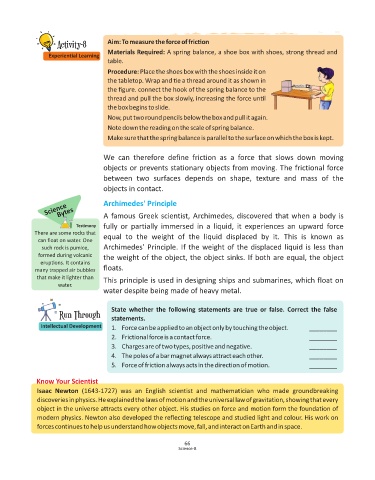
Activity-8       Aim: To measure the force of fric on
                                      Materials Required: A spring balance, a shoe box with shoes, strong thread and
                  Experiential Learning
                                      table.
                                      Procedure: Place the shoes box with the shoes inside it on
                                      the tabletop. Wrap and  e a thread around it as shown in
                                      the figure. connect the hook of the spring balance to the
                                      thread and pull the box slowly, increasing the force un l
                                      the box begins to slide.

                                      Now, put two round pencils below the box and pull it again.
                                      Note down the reading on the scale of spring balance.
                                      Make sure that the spring balance is parallel to the surface on which the box is kept.


                                     We  can  therefore  define  friction  as  a  force  that  slows  down  moving
                                     objects or prevents stationary objects from moving. The frictional force

                                     between  two  surfaces  depends  on  shape,  texture  and  mass  of  the
                                     objects in contact.


                 Science             Archimedes' Principle
                     Bytes
                                     A famous Greek scientist, Archimedes, discovered that when a body is
                           Testimony  fully  or  partially  immersed  in  a  liquid,  it  experiences  an  upward  force
             There are some rocks that
              can float on water. One   equal  to  the  weight  of  the  liquid  displaced  by  it.  This  is  known  as
               such rock is pumice,   Archimedes' Principle. If the weight of the displaced liquid is less than
              formed during volcanic   the weight of the object, the object sinks. If both are equal, the object
               erup ons. It contains
             many trapped air bubbles   floats.
              that make it lighter than   This principle is used in designing ships and submarines, which float on
                     water.
                                     water despite being made of heavy metal.


                                        State  whether  the  following  statements  are  true  or  false.  Correct  the  false
                      Run Through
                                        statements.
               Intellectual Development  1.  Force can be applied to an object only by touching the object.       ________
                                        2.  Frictional force is a contact force.                             ________
                                        3.  Charges are of two types, positive and negative.                 ________
                                        4.  The poles of a bar magnet always attract each other.              ________
                                        5.  Force of friction always acts in the direction of motion.           ________


              Know Your Scientist
              Isaac  Newton  (1643-1727)  was  an  English  scientist  and  mathematician  who  made  groundbreaking
              discoveries in physics. He explained the laws of motion and the universal law of gravitation, showing that every
              object in the universe attracts every other object. His studies on force and motion form the foundation of
              modern physics. Newton also developed the reflecting telescope and studied light and colour. His work on
              forces continues to help us understand how objects move, fall, and interact on Earth and in space.


                                                                 66
                                                               Science-8

