


Page 69 - Innovator's Science-8
P. 69
11.  If a ball is thrown upwards, it slows down, stops momentarily, and then falls back to the ground. Name
                   the forces ac ng on the ball and specify their direc ons.
                   i.  During its upward mo on
                   ii.  During its downward mo on
                   iii. At its topmost posi on
              Ans.  When a ball is thrown upwards, the only force ac ng on it throughout its en re mo on is gravity, which
                   pulls it downwards. However, depending on the mo on of the ball, the direc on of this force rela ve to
                   the ball’s velocity changes.
                   i.  During its upward mo on: The force of gravity is downwards, opposing the upward mo on of the
                      ball, causing it to slow down.
                   ii.  During its downward mo on: The force of gravity is s ll downwards, but now it aligns with the ball’s
                      direc on of mo on, accelera ng it downwards.
                   iii. At its topmost posi on: The ball has zero velocity, meaning it’s momentarily sta onary. At this point,
                      the force of gravity is s ll downwards, but since the ball is not moving upwards or downwards, it has
                      no net effect on the ball’s mo on.

              12.  A ball is released from the point P and moves along an inclined
                   plane and then along a horizontal surface as shown in the figure. It
                   comes to a stop at point A on the horizontal surface. Think of a way
                   so that when the ball is released from the same point P, it stops (i)
                   before the point A, (ii) a er crossing the point A.
              Ans.  The ball moves because of two main forces—gravity and fric on. When it rolls down a slope, gravity
                   makes it speed up. On a flat surface, only fric on acts on it, slowing it down.
                    If fric on is stronger, the ball will slow down faster and stop before reaching point A. If fric on is weaker,
                   the ball will roll farther and stop a er passing point A.
              13.  The weight of an object on the Moon becomes one-sixth of its weight on Earth. What causes this
                   change? Does the mass of the object also become one-sixth of its mass on the Earth?
              Ans.  An object weighs less on the Moon because the Moon’s gravity is much weaker than Earth’s—about one-
                   sixth as strong. However, the object’s mass stays the same everywhere; only its weight changes because
                   weight depends on gravity.
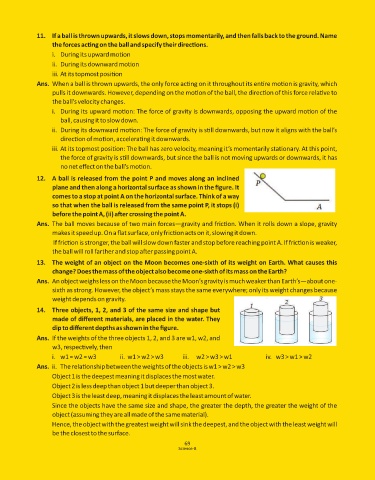
              14.  Three objects, 1, 2, and 3 of the same size and shape but
                   made of different materials, are placed in the water. They
                   dip to different depths as shown in the figure.
              Ans.  If the weights of the three objects 1, 2, and 3 are w1, w2, and
                   w3, respec vely, then
                   i.  w1 = w2 = w3        ii.  w1 > w2 > w3    iii.     w2 > w3 > w1        iv.   w3 > w1 > w2
              Ans.  ii.  The rela onship between the weights of the objects is w1 > w2 > w3
                   Object 1 is the deepest meaning it displaces the most water.

                   Object 2 is less deep than object 1 but deeper than object 3.
                   Object 3 is the least deep, meaning it displaces the least amount of water.
                   Since the objects have the same size and shape, the greater the depth, the greater the weight of the
                   object (assuming they are all made of the same material).
                   Hence, the object with the greatest weight will sink the deepest, and the object with the least weight will
                   be the closest to the surface.
                                                                 69
                                                               Science-8

