


Page 74 - Innovator's Science-8
P. 74
It makes difficult for us to drive while moving against the wind       .

                                     2.  Similarly, while rowing a sail boat, we find that it is easier to row the
                                        sail  boat  in  the  direction  of  wind.  It  is  difficult  to  row  a  sail  boat
                                        opposite side to the direction of wind.

                                     3.  When we are flying a kite, then the wind coming from our back side
                                        helps the kite to fly higher and higher. It is the blowing wind which
                                        exerts the pressure on the kite to fly higher.

                                     4.  When air is filled in a bicycle tube with the help of an air pump, it
                                        inflates. Here it is the pressure exerted by air filled in a bicycle tube

                                        which  keeps  the  tube  ‘tight’  and  makes  the  bicycle  tube  feel  hard.
                                        However,  if  we  fill  too  much  air,  the  bicycle  tube  bursts  because  it
                                        cannot withstand huge pressure of air.

                                        All  the  above  experiences  show  that  moving  air  (or  wind)  exerts  a
                                        force (or pressure) on objects.


                     Activity-1       Aim: To observe that warm air expands and becomes lighter.
                                      Materials Required: An empty glass bo le, a balloon, a bowl of hot water, a bowl of
                  Experiential Learning
                                      cold water.
                                      Procedure:

                                      1.  Stretch the balloon and fit it  ghtly over the mouth of the empty glass bo le.
                 Science              2.  Place the bo le in a bowl of hot water and observe the balloon.
                     Bytes
                                      3.  A er a few minutes, take the bo le out and place it in cold water.
                           Testimony
             When air inside the bo le   4.  Observe what happens to the balloon.
              is heated, the molecules   Observa on: The balloon inflates when the bo le is in hot water and shrinks when
               move faster and need   placed in cold water.
              more space. This is why   Conclusion: When air is heated, it expands and becomes lighter. When cooled, it
              the balloon inflates - it's
              the same principle that   contracts and becomes denser.
              makes hot air balloons   This explains why warm air rises an important cause of winds and air pressure
                      rise.
                                      differences.


                                     WHAT CAUSES AIR PRESSURE?
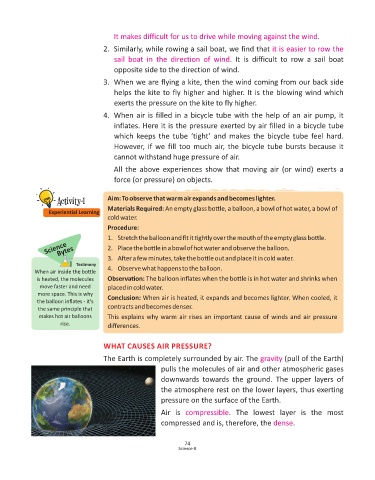
                                     The Earth is completely surrounded by air. The gravity         (pull of the Earth)

                                                         pulls the molecules of air and other atmospheric gases
                                                         downwards  towards  the  ground.  The  upper  layers  of
                                                         the atmosphere rest on the lower layers, thus exerting

                                                         pressure on the surface of the Earth.
                                                         Air  is  compressible  .  The  lowest  layer  is  the  most
                                                         compressed and is, therefore, the dense      .


                                                                 74
                                                               Science-8

