


Page 79 - Innovator's Science-8
P. 79
•  As the warm and moist air (containing a lot of water vapour) rise high
                                        up in the atmosphere, it gets cooled and the water vapour present in

                                        it condenses to form cloud called thunder clouds when water vapour
                                        condenses, it releases heat.
                                     •  The  heat  released  by  the  condensation  of  water  vapour  in  the

                                        atmosphere warms the air all around. This warm air rises higher into
                                        the  atmosphere  causing  a  low  pressure.  More  air  rushed  to  the
                                        centre of the storm. This cycle is repeated.

                                     •  The chain of events ends with the formation of a very low pressure
                                        system with very high-speed winds revolving around it. The weather
                                        condition consisting of a system of high speed winds revolving around

                                        a  central  area  of  very  low  pressure  to  the  centre  of  the  cyclone  is
                                        called its eye.

                                     •  Once a cyclone is formed,
                                        it begins to move over the         Northern Hemisphere      Southern Hemisphere
                                        surface  of  ocean.  The
                 Science                speed  of  wind  in  the
                     Bytes


                           Testimony    cyclone  is  more  than  120
                                        km.  A  cyclone  needs  a
              The calm region at the
               centre of a cyclone is   constant  supply of warm
              called the eye. It may be   and  moist  air.  When  air
             20-40 km wide, with clear   gradually     stops,      the
               skies and light winds,
              even while violent winds   cyclone dies down.
                rage all around it.
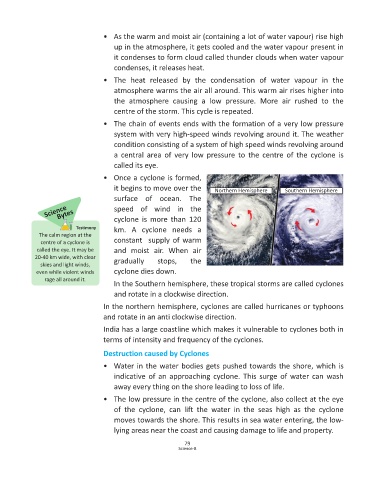
                                        In the Southern hemisphere, these tropical storms are called cyclones
                                        and rotate in a clockwise direction.
                                     In the northern hemisphere, cyclones are called hurricanes or typhoons

                                     and rotate in an anti clockwise direction.
                                     India has a large coastline which makes it vulnerable to cyclones both in
                                     terms of intensity and frequency of the cyclones.


                                     Destruction caused by Cyclones
                                     •  Water in the water bodies gets pushed towards the shore, which is
                                        indicative of an approaching cyclone. This surge of water can wash

                                        away every thing on the shore leading to loss of life.
                                     •  The low pressure in the centre of the cyclone, also collect at the eye

                                        of  the  cyclone,  can  lift  the  water  in  the  seas  high  as  the  cyclone
                                        moves towards the shore. This results in sea water entering, the low-
                                        lying areas near the coast and causing damage to life and property.

                                                                 79
                                                               Science-8

