


Page 76 - Innovator's Science-8
P. 76
MOVEMENT OF AIR

                                     Blowing or moving air is called wind. The speed of wind may vary  from
                                     5-10 km/h (gentle breeze) to 700-800 km/h (tornado).

                                     The speed and direction of wind is affected by the following factors :
                                     •  Location on the earth                   •  Rotation of the earth

                                     •  Local conditions                        •  Height from the ground


                                     EFFECTS OF AIR PRESSURE
                                     Winds are caused due to difference in air pressure. Warm air is lighter. As
                                     it rises, it cools and spreads. Once it is cooled, the air starts moving back

                                     to  the  Earth.  The  region  from  where  the  air  rises,  an  area  of  lower
                                     pressure is created.

                                     The region where the air sinks, an area of high pressure is created. Since
                                     the atmosphere constantly works to restore a balance, air moves in from
                                     an area of high pressure to an area of low pressure. The movement of air

                 Science             is known as wind.
                     Bytes
                                     Atmospheric pressure influences weather

                           Testimony  Upward movement of air causes cloudy and the downward movement of
               Winds do not blow in
              straight lines because of   air causes clear sky.
              the Earth's rota on. This
             deflec on of moving air is   As  air  rises  and  creates  an  area  of  low  pressure,  water  vapour  in  it
              called the Coriolis Effect,   condenses to form clouds. Conversely sinking air generally means that
             and it makes winds curve   condensation cannot take place.
                to the right in the
               Northern Hemisphere   Low  pressure  is,  therefore,  associated  with  cloudy  skies  and  wet
               and to the le  in the   weather.
              Southern Hemisphere.
                                     High pressure is therefore associated with clear and sunny sky.

                                     Generation of Wind
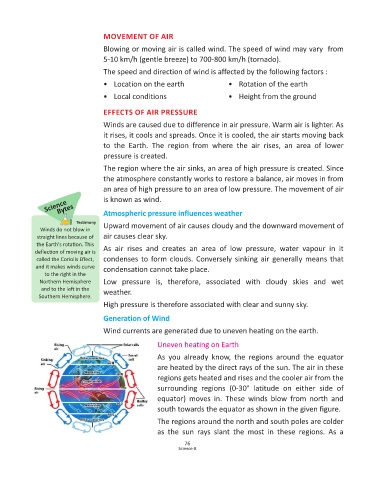
                                     Wind currents are generated due to uneven heating on the earth.


                                                       Uneven heating on Earth
                                                       As  you  already  know,  the  regions  around  the  equator
                                                       are heated by the direct rays of the sun. The air in these

                                                       regions gets heated and rises and the cooler air from the
                                                       surrounding  regions  (0-30°  latitude  on  either  side  of
                                                       equator)  moves  in.  These  winds  blow  from  north  and
                                                       south towards the equator as shown in the given figure.

                                                       The regions around the north and south poles are colder
                                                       as  the  sun  rays  slant  the  most  in  these  regions.  As  a

                                                                 76
                                                               Science-8

