


Page 138 - Journeys Through Society-7
P. 138
expected to dress.                                      sati-an inhuman practice in which a widow was burnt
                                                                    alive on the pyre of her dead husband. Ishwar Chandra
            Gender Inequality                                       Vidyasagar was responsible for the legislation of the

            Gender inequality has existed since ancient times. The   Widow Remarriage Act in 1856. Dayanand Saraswati
            most  widespread  gender  stereotype  is  that  of  a   opened a number of schools and colleges to promote
            woman as a housewife, cook or mother. Her work is       education for girls. All these reformers emphasised
            not valued because it does not generate income for      that a nation can progress only when the condition of
            the family, although, economists consider it unpaid     women  improves.  The  Constitution  of  India  grants
            labour. In general, in almost all societies, women face   equal  rights  to  men  and  women  in  all  spheres.
            discrimination and are given a low status in society.   However,  even  after  more  than  75  years  of
                                                                    independence, gender equality is still a distant dream.
                     Wow Fact
                                                                                Wow Fact
                      The  use  of  digital  technologies,  such  as  AI  is
                      transforming  labour  markets  around  the  world.        The  COVID-19  pandemic  worsened  gender
                      Their  use  is  creating  both  challenges  and           inequality.
                      opportunities  for  the  working  lives  of  women.
                      Societies and economies need to prepare for the
                      future  of  work  by  considering  the  influence  of   Government’s Efforts Towards Equality
                      technology on gender equality.
                                                                    We see inequality in the form of a lack of appreciation
                                                                    for women's unpaid labour, household work and paid
                                                                    jobs. According to a survey conducted, women work
                                                                    one hour more as compared to men but their work is
                                                                    undervalued  and  unpaid.  In  a  society  like  India,
                                                                    household duties and family responsibilities primarily
                                                                    fall on the shoulders of women. The government has
                                                                    taken  remedial  measures  in  this  direction.  State
                                                                    governments  have  initiated  many  schemes  to
                                                                    encourage parents to send their daughters to schools
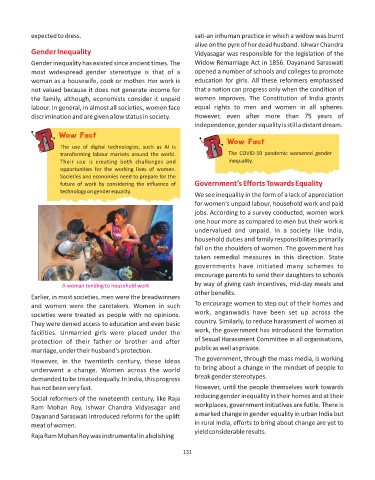
                       A woman tending to household work            by way of giving cash incentives, mid-day meals and
                                                                    other benefits.
            Earlier, in most societies, men were the breadwinners
            and  women  were  the  caretakers.  Women  in  such     To encourage women to step out of their homes and
                                                                    work,  anganwadis  have  been  set  up  across  the
            societies  were  treated  as  people  with  no  opinions.
            They were denied access to education and even basic     country. Similarly, to reduce harassment of women at
                                                                    work, the government has introduced the formation
            facilities.  Unmarried  girls  were  placed  under  the
            protection  of  their  father  or  brother  and  after   of Sexual Harassment Committee in all organisations,
            marriage, under their husband's protection.             public as well as private.
                                                                    The government, through the mass media, is working
            However,  in  the  twentieth  century,  these  ideas
            underwent  a  change.  Women  across  the  world        to bring about a change in the mindset of people to
            demanded to be treated equally. In India, this progress   break gender stereotypes.
            has not been very fast.                                 However, until the people themselves work towards
            Social reformers of the nineteenth century, like Raja   reducing gender inequality in their homes and at their
                                                                    workplaces, government initiatives are futile. There is
            Ram  Mohan  Roy,  Ishwar  Chandra  Vidyasagar  and
                                                                    a marked change in gender equality in urban India but
            Dayanand Saraswati introduced reforms for the uplift
            meat of women.                                          in rural India, efforts to bring about change are yet to
                                                                    yield considerable results.
            Raja Ram Mohan Roy was instrumental in abolishing


                                                                131

