


Page 143 - Journeys Through Society-7
P. 143
Schooling and Education Today                           women's  movement.  Women  all  over  the  country
                                                                    have contributed individually and collectively to bring
            Today,  both  boys  and  girls  attend  school  in  large
                                                                    about these changes.
            numbers.  Yet,  as  we  will  see,  there  still  remain
            differences between the education of boys and girls.    The  women's  movement  in  India  has  acquired  a
            India has a census every 10 years, which counts the     dynamic  character  through  the  efforts  of  many
            whole  population  of  the  country.  It  also  gathers   people, both men and women. The changes began in
            detailed information about the people living in India -   the  nineteenth  century.  The  early  campaigns  were
            their age, schooling, what work they do, and so on. We   directed against the purdah system, and social evils
            use this information to measure many things, like the   like the practice of sati, child marriage and illiteracy. It
            number of literate people, and the ratio of men and     was led by prominent women leaders like Kamladevi
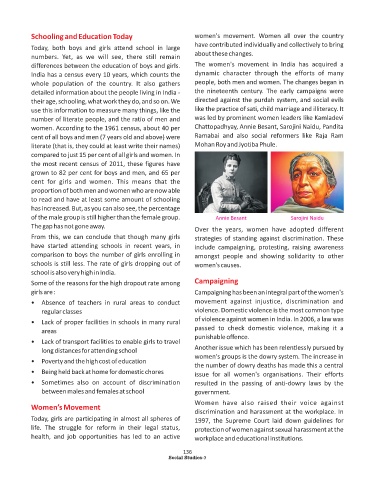
            women. According to the 1961 census, about 40 per       Chattopadhyay, Annie Besant, Sarojini Naidu, Pandita
            cent of all boys and men (7 years old and above) were   Ramabai  and  also  social  reformers  like  Raja  Ram
            literate (that is, they could at least write their names)   Mohan Roy and Jyotiba Phule.
            compared to just 15 per cent of all girls and women. In
            the most recent census of 2011, these figures have
            grown to 82 per cent for boys and men, and 65 per
            cent  for  girls  and  women.  This  means  that  the
            proportion of both men and women who are now able
            to read and have at least some amount of schooling
            has increased. But, as you can also see, the percentage
            of the male group is still higher than the female group.        Annie Besant              Sarojini Naidu
            The gap has not gone away.
                                                                    Over  the  years,  women  have  adopted  different
            From this, we can conclude that though many girls       strategies  of  standing  against  discrimination.  These
            have  started  attending  schools  in  recent  years,  in   include  campaigning,  protesting,  raising  awareness
            comparison to boys the number of girls enrolling in     amongst  people  and  showing  solidarity  to  other
            schools is still less. The rate of girls dropping out of   women’s causes.
            school is also very high in India.
            Some of the reasons for the high dropout rate among     Campaigning
            girls are :                                             Campaigning has been an integral part of the women's

            •  Absence  of  teachers  in  rural  areas  to  conduct   movement  against  injustice,  discrimination  and
               regular classes                                      violence. Domestic violence is the most common type
                                                                    of violence against women in India. In 2006, a law was
            •  Lack of proper facilities in schools in many rural
                                                                    passed  to  check  domestic  violence,  making  it  a
               areas
                                                                    punishable offence.
            •  Lack of transport facilities to enable girls to travel
                                                                    Another issue which has been relentlessly pursued by
               long distances for attending school
                                                                    women's groups is the dowry system. The increase in
            •  Poverty and the high cost of education
                                                                    the number of dowry deaths has made this a central
            •  Being held back at home for domestic chores          issue  for  all  women's  organisations.  Their  efforts
            •  Sometimes  also  on  account  of  discrimination     resulted  in  the  passing  of  anti-dowry  laws  by  the
               between males and females at school                  government.
                                                                    Women  have  also  raised  their  voice  against
            Women’s Movement
                                                                    discrimination and harassment at the workplace. In
            Today, girls are participating in almost all spheres of   1997,  the  Supreme  Court  laid  down  guidelines  for
            life.  The  struggle  for  reform  in  their  legal  status,   protection of women against sexual harassment at the
            health,  and  job  opportunities  has  led  to  an  active   workplace and educational institutions.

                                                                136
                                                           Social Studies-7

