


Page 144 - Journeys Through Society-7
P. 144
Raising Awareness                                       Contemporary Women’s Movement

            The women’s movements play an important role in         The  Self-Employed  Women's  Association  (SEWA)
            raising  public  awareness  on  women's  rights.  These   movement in Ahmedabad led by Ela Bhatt, that began
            include issues like health, education and protection    in  1972,  was  a  pioneering  women's  trade  union
            under  law.  Awareness-  raising  campaigns  are        movement. It was a landmark in the history of the
            undertaken  in  the  forms  of  street  plays,  public   contemporary women's movement. Women involved
            meetings, cultural programme, etc.                      in various trades in the informal sector were brought
                                                                    together  by  their  shared  experiences  such  as  low
            Women’s movements also focus on the violation of
                                                                    earnings,  harassment  at  home,  harassment  by
            women’s rights. If an act or law violates their interest,
                                                                    contractors and the police, poor work conditions, non-
            they  protest  against  it.  Public  attention  is  sought
                                                                    recognition of their labour, etc. Apart from collective
            through demonstrations and rallies.
                                                                    bargaining,  the  movement  strove  to  improve  the
            Protesting                                              working conditions through training.

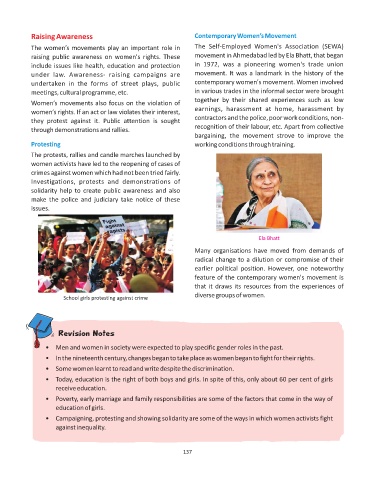
            The protests, rallies and candle marches launched by
            women activists have led to the reopening of cases of
            crimes against women which had not been tried fairly.
            Investigations,  protests  and  demonstrations  of
            solidarity help to create public awareness and also
            make  the  police  and  judiciary  take  notice  of  these
            issues.


                                                                                          Ela Bhatt
                                                                    Many  organisations  have  moved  from  demands  of
                                                                    radical change to a dilution or compromise of their
                                                                    earlier  political  position.  However,  one  noteworthy
                                                                    feature of the contemporary women's movement is
                                                                    that it draws its resources from the experiences of
                                                                    diverse groups of women.
                       School girls protesting against crime


                     Revision Notes

                 •  Men and women in society were expected to play specific gender roles in the past.
                 •  In the nineteenth century, changes began to take place as women began to fight for their rights.

                 •  Some women learnt to read and write despite the discrimination.
                 •  Today, education is the right of both boys and girls. In spite of this, only about 60 per cent of girls
                    receive education.
                 •  Poverty, early marriage and family responsibilities are some of the factors that come in the way of
                    education of girls.

                 •  Campaigning, protesting and showing solidarity are some of the ways in which women activists fight
                    against inequality.


                                                                137

