


Page 58 - Journeys Through Society-7
P. 58
•  The mansabdars system had lost its importance        The Later Mughals
               since the powers of the mansabdars and subedars      Aurangzeb’s  successors,  called  the  later  Mughals,
               went unchecked.                                      ruled  for  150  years  (1707-1857).  Important  among
            •  The  collection  of  revenue  from  the  provinces   them  were:  Bahadur  Shah  I,  Jahandar  Shah,
               became  uneven  as  the  centre  was  unable  to     Farrukhsiyar and Muhammad Shah. The later mughals
               control the regularity of the process.               were weak and could not hold the empire together.
            •  Aurangzeb’s strict pollitical policies also angered   During  their  reign,  independent  kingdoms  rose  in
               the Sikhs, the Rajputs, the Jats and the Marathas    every  part  of  India  and  the  Mughal  Empire  was
               who rose in revolt and shattered the stablity of the   reduced to the area around Delhi.
               Mughal empire.                                       After the death of Aurangzeb, his son Bahadur Shah I
            •  Inefficient successors of Aurangzeb, stagnation in   ascended the throne after defeating his two brothers
               intellectual  and  military  spheres  and  lack  of   in 1707. He took the title of Shah Alam. His reign saw
               advancement  in  military  equipment  further        the rise of the Marathas, the Rajputs and the Sikhs. He
               contributed to the decline of the empire.            was succeeded by Jahandar Shah.
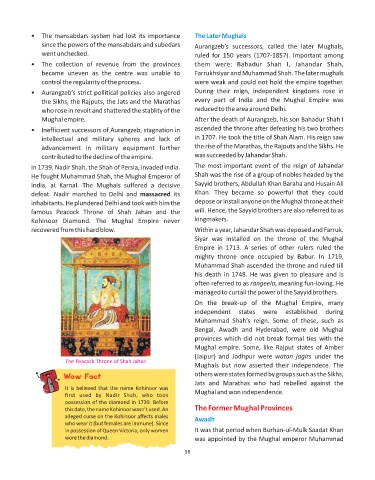
            In 1739, Nadir Shah, the Shah of Persia, invaded India.   The most important event of the reign of Jahandar
            He fought Muhammad Shah, the Mughal Emperor of          Shah was the rise of a group of nobles headed by the
            India,  at  Karnal.  The  Mughals  suffered  a  decisive   Sayyid brothers, Abdullah Khan Baraha and Husain Ali
            defeat.  Nadir  marched  to  Delhi  and  massacred  its   Khan.  They  became  so  powerful  that  they  could
            inhabitants. He plundered Delhi and took with him the   depose or install anyone on the Mughal throne at their
            famous  Peacock  Throne  of  Shah  Jahan  and  the      will. Hence, the Sayyid brothers are also referred to as
            Kohinoor  Diamond.  The  Mughal  Empire  never          kingmakers.
            recovered from this hard blow.                          Within a year, Jahandar Shah was deposed and Farruk.
                                                                    Siyar  was  installed  on  the  throne  of  the  Mughal
                                                                    Empire  in  1713.  A  series  of  other  rulers  ruled  the
                                                                    mighty  throne  once  occupied  by  Babur.  In  1719,
                                                                    Muhammad Shah ascended the throne and ruled till
                                                                    his death in 1748. He was given to pleasure and is
                                                                    often referred to as rangeela, meaning fun-loving. He
                                                                    managed to curtail the power of the Sayyid brothers.

                                                                    On  the  break-up  of  the  Mughal  Empire,  many
                                                                    independent  states  were  established  during
                                                                    Muhammad  Shah’s  reign.  Some  of  these,  such  as
                                                                    Bengal,  Awadh  and  Hyderabad,  were  old  Mughal
                                                                    provinces which did not break formal ties with the
                                                                    Mughal  empire.  Some,  like  Rajput  states  of  Amber
                                                                    (Jaipur)  and  Jodhpur  were  watan  jagirs  under  the
                        The Peacock Throne of Shah Jahan
                                                                    Mughals  but  now  asserted  their  independece.  The
                       Wow Fact                                     others were states formed by groups such as the Sikhs,
                                                                    Jats  and  Marathas  who  had  rebelled  against  the
                       It is believed that the name Kohinoor was    Mughal and won independence.
                       first  used  by  Nadir  Shah,  who  took
                       possession of the diamond in 1739. Before
                       this date, the name Kohinoor wasn’t used. An   The Former Mughal Provinces
                       alleged curse on the Kohinoor affects males   Awadh
                       who wear it (but females are immune). Since
                       in possession of Queen Victoria, only women   It was that period when Burhan-ul-Mulk Saadat Khan
                       wore the diamond.                            was appointed by the Mughal emperor Muhammad

                                                                 58

