


Page 61 - Journeys Through Society-7
P. 61
The Marathas                                            and put him under house arrest. He was able to escape
            The Marathas’ Empire also referred to as the Maratha    secretly.
            confederacy was an early modern Indian empire and       Shivaji crowned himself Chhatrapati or the sovereign
            later a confederation that rose to dominate much of     ruler  in  Raigad  in  1674.  He  overran  the  Deccan,
            the  Indian  subcontinent  in  the  18th  century.  An   capturing Ginjee and Vellore in southern India, the
            important chieftain of the Bhonsle clan was Shahji, a   Kopal and Bellary below Kaveri in Karnataka. He died
            high official in the Bijapur kingdom. He brought the    in 1680 leaving behind a powerful kingdom.
            Marathas into prominence by establishing their hold     Shivaji’s Administration
            over the Deccan region.
                                                                    Shivaji developed a fairly effective, political, military
            Shivaji                                                 and financial administrative system. Shivaji ruled his
            The Marathas became prominent under the rule of         kingdom with the help of a council of ministers called
            Shivaji. Though Shahji can be termed as the founder of   the Ashtapradhan, or the important eight. The most
            the confederacy, the credit of carving out a separate   important  of  them  were  the  Peshwa  or  the  prime
            empire for the Marathas goes to his son, Shivaji. Born   minister and the Senapati, the commander-in-chief of
            in 1627, Shivaji grew up to be fearless warrior under   the army.
            the influence of his mother Jijabai, who brought him    The  main  source  of  revenue  for  the  Maratha
            up by narrating stories of brave men and encouraged     administration  was  the  land  revenue.  The  revenue
            him to take pride in the Maratha culture.               collected was divided into two categories. One, the
            Shivaji wanted to make the                              revenue collected from the territories directly ruled by
            Maratha empire powerful.                                him which amounted to 2/5 of the land’s produce.
            He  is  known  for  the                                 Two,  Shivaji  also  charged  taxes,  chauth  and
            guerilla  warfare  by  which                            sardeshmukhi, from other rulers of south India.
            surprise   attacks   were                               Chauth was 1/4 of the land revenue to be paid by the
            made on the enemy. This                                 rulers and was paid to ensure that the Marathas would
            unique  technique  gave                                 not raid their territories.
            them         considerable
                                                                    Sardeshmukhi  was  another  additional  tax  which
            advantage    over    their
                                                                    amounted to 1/10 of the produce.
            adversaries,  the  Mughals
                                                                    Shivaji’s Army
            and the Sultans of Bijapur,
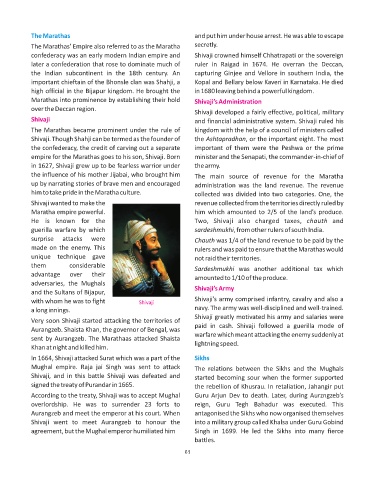
            with whom he was to fight            Shivaji            Shivaji’s army comprised infantry, cavalry and also a
            a long innings.                                         navy. The army was well-disciplined and well-trained.
                                                                    Shivaji greatly motivated his army and salaries were
            Very soon Shivaji started attacking the territories of
                                                                    paid  in  cash.  Shivaji  followed  a  guerilla  mode  of
            Aurangzeb. Shaista Khan, the governor of Bengal, was
                                                                    warfare which meant attacking the enemy suddenly at
            sent by Aurangzeb. The Marathaas attacked Shaista
                                                                    lightning speed.
            Khan at night and killed him.
            In 1664, Shivaji attacked Surat which was a part of the   Sikhs
            Mughal  empire.  Raja  jai  Singh  was  sent  to  attack   The  relations  between  the  Sikhs  and  the  Mughals
            Shivaji,  and  in  this  battle  Shivaji  was  defeated  and   started becoming sour when the former supported
            signed the treaty of Purandar in 1665.                  the rebellion of Khusrau. In retaliation, Jahangir put

            According to the treaty, Shivaji was to accept Mughal   Guru Arjun Dev to death. Later, during Aurzngzeb’s
            overlordship.  He  was  to  surrender  23  forts  to    reign,  Guru  Tegh  Bahadur  was  executed.  This
            Aurangzeb and meet the emperor at his court. When       antagonised the Sikhs who now organised themselves
            Shivaji  went  to  meet  Aurangzeb  to  honour  the     into a military group called Khalsa under Guru Gobind
            agreement, but the Mughal emperor humiliated him        Singh  in  1699.  He  led  the  Sikhs  into  many  fierce
                                                                    battles.

                                                                 61

