


Page 62 - Journeys Through Society-7
P. 62
After the death of Guru Gobind                          From 1713 to 1761, the marathas were controlled by
            Singh, the struggle against the                         the  Peshwas.  In  1713,  Shivaji’s  grandson  Shahuji,
            Mughal  authority  was  carried                         appointed Balaji Vishwanath as his Peshwa. He was an
            on  by  Banda  Bahadur.  By  the                        able  administrator  and  the  office  of  the  Peshwa
            early  eighteenth  century,  the                        became hereditary under him.
            Sikhs    had      consolidated                          Baji Rao I (1720-1740)
            themselves by carving out their
                                                                    Baji Rao I succeeded his father Balaji Vishwanath and
            kingdom  between  the  Sutlej
                                                                    pursued an ambitious expansionist policy. Baji Rao I,
            and  the  Yamuna  rivers  which   Guru Tegh Bahadur
                                                                    was  a  noted  general  who  served  as  Peshwa.  He
            came  to  be  known  as  Punjab.  They  organised
                                                                    pursued  an  expansionist  policy  and  is  credited  for
            themselves into 12 political groups called the misls.
                                                                    expanding the Maratha Empire by capturing Malwa,
            Each misl was under a leader and dominated a specific
                                                                    southern  Gujarat  and  parts  of  Bundelkhand.  He
            area. These misls often fought among each other to
                                                                    annexed Salsette and Bassein from the Protguese.
            expand  their  territories.
                                                                    Balaji Baji Rao (1740-1761)
            Ranjeet  Singh  established
            one    of   the   strongest                             Baji  Rao’s  son,  Balaji  Baji  Rao  (Nanasaheb),  was
            kingdoms  of  the  period.                              appointed as a Peshwa by Shahuji. When Shahuji died
            Thereafter    he     added                              in  1749,  Balaji  Baji  Rao  became  the  head  of  the
            Peshawar,    Multan     and                             Marathas. Under Balaji Baji Rao, the Maratha army
            Kashmir  as  part  of  his                              went on expeditions to several parts of the country.
            empire.                                                 The Marathas reached their zenith under him.

            Rise of the Peshwas                  Shahuji            Third Battle of Panipat (1761)
                                                                    The Maratha army met Ahmad Shah Abdali’s forces in
                                                                    the third battle of Panipat in 1761. The growth of the
                                                                    Marathas made the Jats, the Sikhs, and the rulers of
                                                                    Bengal and Hyderabad anxious. So when the Marathas
                                                                    clashed  with  Abdali  none  of  them  came  to  the
                                                                    Maratha  rescue.  As  a  result,  they  were  completely
                                                                    routed. The various Maratha chiefs began to rule over
                                                                    their own areas. This paved the way for the English
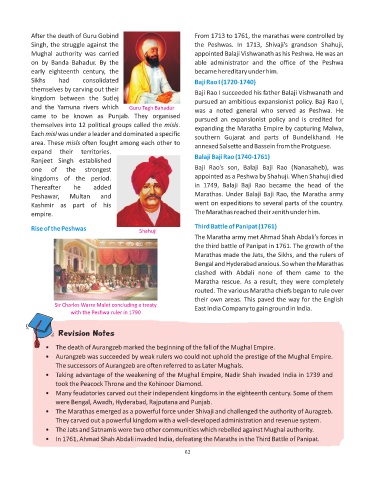
                    Sir Charles Warre Malet concluding a treaty     East India Company to gain ground in India.
                         with the Peshwa ruler in 1790


                     Revision Notes

                 •  The death of Aurangzeb marked the beginning of the fall of the Mughal Empire.
                 •  Aurangzeb was succeeded by weak rulers wo could not uphold the prestige of the Mughal Empire.
                    The successors of Aurangzeb are often referred to as Later Mughals.
                 •  Taking advantage of the weakening of the Mughal Empire, Nadir Shah invaded India in 1739 and
                    took the Peacock Throne and the Kohinoor Diamond.
                 •  Many feudatories carved out their independent kingdoms in the eighteenth century. Some of them
                    were Bengal, Awadh, Hyderabad, Rajputana and Punjab.
                 •  The Marathas emerged as a powerful force under Shivaji and challenged the authority of Auragzeb.
                    They carved out a powerful kingdom with a well-developed administration and revenue system.
                 •  The Jats and Satnamis were two other communities which rebelled against Mughal authority.
                 •  In 1761, Ahmad Shah Abdali invaded India, defeating the Maraths in the Third Battle of Panipat.

                                                                 62

