


Page 60 - Journeys Through Society-7
P. 60
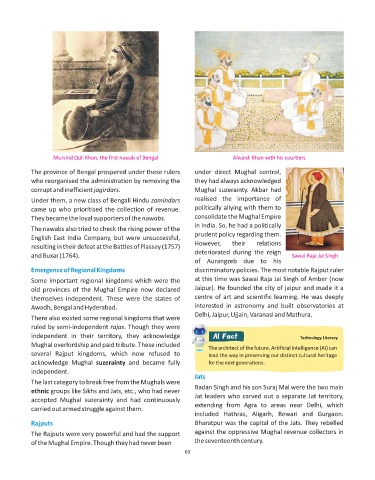
Murshid Quli Khan, the first nawab of Bengal                   Alivardi Khan with his courtiers
            The province of Bengal prospered under these rulers     under  direct  Mughal  control,
            who reorganised the administration by removing the      they had always acknowledged
            corrupt and inefficient jagirdars.                      Mughal  suzerainty.  Akbar  had
            Under them, a new class of Bengali Hindu zamindars      realised  the  importance  of
            came up who prioritised the collection of revenue.      politically allying with them to
            They became the loyal supporters of the nawabs.         consolidate the Mughal Empire
                                                                    in India. So, he had a politically
            The nawabs also tried to check the rising power of the
                                                                    prudent policy regarding them.
            English East India Company, but were unsuccessful,
                                                                    However,     their    relations
            resulting in their defeat at the Battles of Plassey (1757)
                                                                    deteriorated  during  the  reign
            and Buxar (1764).                                                                         Sawai Raja Jai Singh
                                                                    of  Aurangzeb  due  to  his
            Emergence of Regional Kingdoms                          discriminatory policies. The most notable Rajput ruler
            Some important regional kingdoms which were the         at this time was Sawai Raja Jai Singh of Amber (now
            old  provinces  of  the  Mughal  Empire  now  declared   Jaipur). He founded the city of jaipur and made it a
            themselves  independent.  These  were  the  states  of   centre of art and scientific learning. He was deeply
            Awadh, Bengal and Hyderabad.                            interested  in  astronomy  and  built  observatories  at
                                                                    Delhi, Jaipur, Ujjain, Varanasi and Mathura.
            There also existed some regional kingdoms that were
            ruled by semi-independent rajas. Though they were
            independent  in  their  territory,  they  acknowledge          AI Fact                       Technology Literacy
            Mughal overlordship and paid tribute. These included
                                                                         The architect of the future, Artificial Intelligence (AI) can
            several  Rajput  kingdoms,  which  now  refused  to          lead the way in preserving our distinct cultural heritage
            acknowledge  Mughal  suzerainty  and  became  fully          for the next generations.
            independent.
                                                                    Jats
            The last category to break free from the Mughals were
                                                                    Badan Singh and his son Suraj Mal were the two main
            ethnic groups like Sikhs and Jats, etc., who had never
                                                                    Jat leaders who carved out a separate Jat territory,
            accepted  Mughal  suzerainty  and  had  continuously
                                                                    extending  from  Agra  to  areas  near  Delhi,  which
            carried out armed struggle against them.
                                                                    included  Hathras,  Aligarh,  Rewari  and  Gurgaon.
            Rajputs                                                 Bharatpur was the capital of the Jats. They rebelled
            The Rajputs were very powerful and had the support      against the oppressive Mughal revenue collectors in
            of the Mughal Empire. Though they had never been        the seventeenth century.
                                                                 60

