


Page 80 - Social Science 2_flatten
P. 80
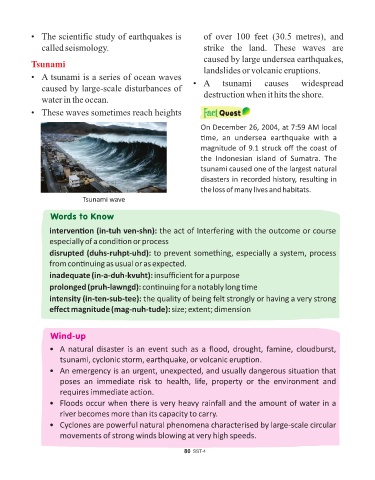
•  The scientific study of earthquakes is                  of  over  100  feet  (30.5  metres),  and

               called seismology.                                      strike  the  land.  These  waves  are
                                                                       caused by large undersea earthquakes,
            Tsunami
                                                                       landslides or volcanic eruptions.
            •  A tsunami is a series of ocean waves
                                                                    •  A      tsunami       causes       widespread
               caused by large-scale disturbances of
                                                                       destruction when it hits the shore.
               water in the ocean.

            •  These waves sometimes reach heights

                                                                      On December 26, 2004, at 7:59 AM local
                                                                       me,  an  undersea  earthquake  with  a
                                                                      magnitude of 9.1 struck off the coast of
                                                                      the  Indonesian  island  of  Sumatra.  The

                                                                      tsunami caused one of the largest natural
                                                                      disasters in recorded history, resulting in
                                                                      the loss of many lives and habitats.
                              Tsunami wave


                  Words to Know

                  interven on (in-tuh ven-shn): the act of Interfering with the outcome or course
                  especially of a condi on or process

                  disrupted (duhs-ruhpt-uhd): to prevent something, especially a system, process
                  from con nuing as usual or as expected.
                  inadequate (in-a-duh-kvuht): insufficient for a purpose

                  prolonged (pruh-lawngd): con nuing for a notably long  me

                  intensity (in-ten-sub-tee): the quality of being felt strongly or having a very strong
                  effect magnitude (mag-nuh-tude): size; extent; dimension


                  Wind-up
                  •  A  natural  disaster  is  an  event  such  as  a  flood,  drought,  famine,  cloudburst,

                      tsunami, cyclonic storm, earthquake, or volcanic eruption.
                  •  An emergency is an urgent, unexpected, and usually dangerous situation that
                      poses  an  immediate  risk  to  health,  life,  property  or  the  environment  and

                      requires immediate action.
                  •  Floods occur when there is very heavy rainfall and the amount of water in a
                      river becomes more than its capacity to carry.

                  •  Cyclones are powerful natural phenomena characterised by large-scale circular
                      movements of strong winds blowing at very high speeds.


                                                                 80 SST-4

