


Page 18 - Code Craft Computer-8
P. 18
Fields

                                        Roll No.        Name         Class           Marks
                                 Records   1           Anshu             6             94

                                                        Ishu
                                                                         8
                                           2
                                                                                       95
                                           3            Ashu            11             92
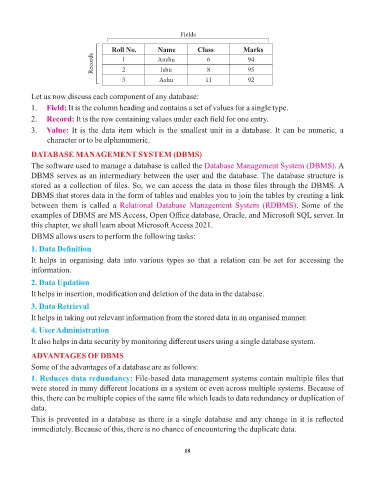
            Let us now discuss each component of any database:

            1.  Field:   It is the column heading and contains a set of values for a single type.
            2.  Record:     It is the row containing values under each field for one entry.

            3.  Value:    It is the data item which is the smallest unit in a database. It can be numeric, a
                 character or to be alphanumeric.

            DATABASE MANAGEMENT SYSTEM (DBMS)
            The software used to manage a database is called the Database Management System (DBMS)                   . A
            DBMS serves as an intermediary between the user and the database. The database structure is
            stored as a collection of files. So, we can access the data in those files through the DBMS. A

            DBMS that stores data in the form of tables and enables you to join the tables by creating a link
            between  them  is  called  a  Relational  Database  Management  System  (RDBMS)            .  Some  of  the
            examples of DBMS are MS Access, Open Office database, Oracle, and Microsoft SQL server. In
            this chapter, we shall learn about Microsoft Access 2021.
            DBMS allows users to perform the following tasks:

            1. Data Definition
            It  helps  in  organising  data  into  various  types  so  that  a  relation  can  be  set  for  accessing  the

            information.
            2. Data Updation

            It helps in insertion, modification and deletion of the data in the database.
            3. Data Retrieval

            It helps in taking out relevant information from the stored data in an organised manner.

            4. User Administration
            It also helps in data security by monitoring different users using a single database system.

            ADVANTAGES OF DBMS
            Some of the advantages of a database are as follows:

            1. Reduces data redundancy: File-based data management systems contain multiple files that
            were stored in many different locations in a system or even across multiple systems. Because of
            this, there can be multiple copies of the same file which leads to data redundancy or duplication of
            data.

            This is prevented in a database as there is a single database and any change in it is reflected
            immediately. Because of this, there is no chance of encountering the duplicate data.


                                                                 18

