


Page 37 - Innovator's Science-8
P. 37
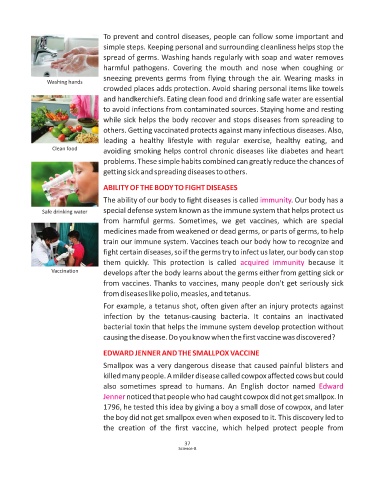
To prevent and control diseases, people can follow some important and
                                     simple steps. Keeping personal and surrounding cleanliness helps stop the

                                     spread of germs. Washing hands regularly with soap and water removes
                                     harmful  pathogens.  Covering  the  mouth  and  nose  when  coughing  or
                                     sneezing prevents germs from flying through the air. Wearing masks in
                 Washing hands
                                     crowded places adds protection. Avoid sharing personal items like towels

                                     and handkerchiefs. Eating clean food and drinking safe water are essential
                                     to avoid infections from contaminated sources. Staying home and resting
                                     while sick helps the body recover and stops diseases from spreading to
                                     others. Getting vaccinated protects against many infectious diseases. Also,

                                     leading  a  healthy  lifestyle  with  regular  exercise,  healthy  eating,  and
                   Clean food
                                     avoiding smoking helps control chronic diseases like diabetes and heart
                                     problems. These simple habits combined can greatly reduce the chances of
                                     getting sick and spreading diseases to others.


                                     ABILITY OF THE BODY TO FIGHT DISEASES
                                     The ability of our body to fight diseases is called immunity     . Our body has a

                Safe drinking water  special defense system known as the immune system that helps protect us
                                     from  harmful  germs.  Sometimes,  we  get  vaccines,  which  are  special
                                     medicines made from weakened or dead germs, or parts of germs, to help
                                     train our immune system. Vaccines teach our body how to recognize and

                                     fight certain diseases, so if the germs try to infect us later, our body can stop
                                     them  quickly.  This  protection  is  called  acquired  immunity       because  it
                   Vaccination       develops after the body learns about the germs either from getting sick or
                                     from vaccines. Thanks to vaccines, many people don't get seriously sick
                                     from diseases like polio, measles, and tetanus.

                                     For example, a tetanus shot, often given after an injury protects against

                                     infection  by  the  tetanus-causing  bacteria.  It  contains  an  inactivated
                                     bacterial toxin that helps the immune system develop protection without
                                     causing the disease. Do you know when the first vaccine was discovered?

                                     EDWARD JENNER AND THE SMALLPOX VACCINE

                                     Smallpox was a very dangerous disease that caused painful blisters and
                                     killed many people. A milder disease called cowpox affected cows but could
                                     also  sometimes  spread  to  humans.  An  English  doctor  named  Edward

                                     Jenner noticed that people who had caught cowpox did not get smallpox. In
                                     1796, he tested this idea by giving a boy a small dose of cowpox, and later
                                     the boy did not get smallpox even when exposed to it. This discovery led to

                                     the  creation  of  the  first  vaccine,  which  helped  protect  people  from

                                                                 37
                                                               Science-8

