


Page 33 - Innovator's Science-8
P. 33
Non-communicable Diseases
                 Science             Non-communicable diseases (NCDs) are medical conditions or diseases
                     Bytes

                                     that are not transmitted from one person to another. They are usually
                           Testimony
                Non-communicable     chronic, lasting for a long time, and result from a combination of genetic,
              disease (NCDs) usually   physiological, environmental, and lifestyle factors. Common examples of
             develop slowly over  me
              due to unhealthy habits   NCDs  include  cardiovascular  diseases  like  heart  attacks  and  strokes,
                  or gene c and      cancers, diabetes, and chronic respiratory diseases. These diseases are the
              environmental factors.
             They are linked to choices   leading causes of death globally, accounting for around 70% of all deaths.
              such as poor diet, stress,   Unlike infectious diseases, NCDs cannot be spread by pathogens and are
                and lack of physical   often linked to unhealthy habits such as poor diet, lack of physical activity,
              ac vity which means a
               healthy life style is the   tobacco use, and excessive alcohol consumption.
                 best preven on.
                                      Communicable Diseases

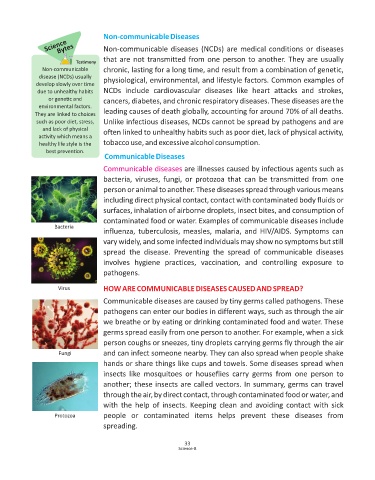
                                     Communicable diseases are illnesses caused by infectious agents such as
                                     bacteria,  viruses,  fungi,  or  protozoa  that  can  be  transmitted  from  one
                                     person or animal to another. These diseases spread through various means
                                     including direct physical contact, contact with contaminated body fluids or

                                     surfaces, inhalation of airborne droplets, insect bites, and consumption of
                                     contaminated food or water. Examples of communicable diseases include
                    Bacteria
                                     influenza, tuberculosis, measles, malaria, and HIV/AIDS. Symptoms can
                                     vary widely, and some infected individuals may show no symptoms but still

                                     spread  the  disease.  Preventing  the  spread  of  communicable  diseases
                                     involves  hygiene  practices,  vaccination,  and  controlling  exposure  to
                                     pathogens.


                     Virus           HOW ARE COMMUNICABLE DISEASES CAUSED AND SPREAD?
                                     Communicable diseases are caused by tiny germs called pathogens. These
                                     pathogens can enter our bodies in different ways, such as through the air

                                     we breathe or by eating or drinking contaminated food and water. These
                                     germs spread easily from one person to another. For example, when a sick
                                     person coughs or sneezes, tiny droplets carrying germs fly through the air

                     Fungi           and can infect someone nearby. They can also spread when people shake
                                     hands or share things like cups and towels. Some diseases spread when
                                     insects  like  mosquitoes  or  houseflies  carry  germs  from  one  person  to
                                     another; these insects are called vectors. In summary, germs can travel
                                     through the air, by direct contact, through contaminated food or water, and

                                     with  the  help  of  insects.  Keeping  clean  and  avoiding  contact  with  sick
                    Protozoa         people  or  contaminated  items  helps  prevent  these  diseases  from
                                     spreading.


                                                                 33
                                                               Science-8

