


Page 63 - Code Craft Computer-8
P. 63
TYPES OF DBMS

            There are four major types of DBMS. These are:
            •    Relational database                   •     Object oriented database
            •    Hierarchical database                 •     Network database

            1.  Relational Database

                 A Relational Database Management System (RDBMS)                is a system where data is organized
                 in two dimensional tables using rows and columns. This is one of the most popular data
                 models which is used in many industries. It is based on  SQL. Every table in a database has a
                 key field which uniquely identifies the every each record.
                 This type of system is the most widely used DBMS right now.

                 Relational  database  management  system  software  is  available  for  personal  computers,
                 workstations and large mainframe systems.
                 For example − Oracle Database, MySQL, Microsoft SQL Server etc.

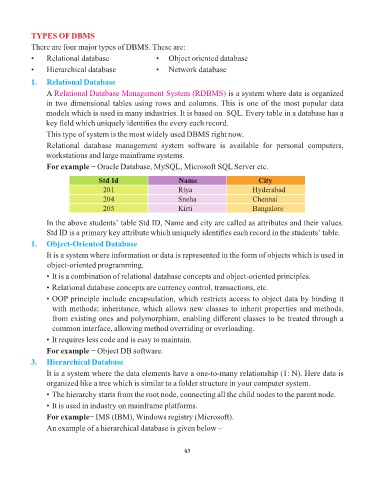
                                   Std Id                      Name                       City
                                     201                       Riya                     Hyderabad
                                     204                       Sneha                    Chennai
                                     205                       Kirti                    Bangalore

                 In the above students’ table Std ID, Name and city are called as attributes and their values.

                 Std ID is a primary key attribute which uniquely identifies each record in the students’ table.
            1.  Object-Oriented Database
                 It is a system where information or data is represented in the form of objects which is used in
                 object-oriented programming.

                 • It is a combination of relational database concepts and object-oriented principles.
                 • Relational database concepts are currency control, transactions, etc.

                 • OOP principle include encapsulation, which restricts access to object data by binding it
                   with methods; inheritance, which allows new classes to inherit properties and methods,
                   from existing ones and polymorphism, enabling different classes to be treated through a
                   common interface, allowing method overriding or overloading.

                 • It requires less code and is easy to maintain.
                 For example − Object DB software.

            3.  Hierarchical Database
                 It is a system where the data elements have a one-to-many relationship (1: N). Here data is
                 organized like a tree which is similar to a folder structure in your computer system.
                 • The hierarchy starts from the root node, connecting all the child nodes to the parent node.

                 • It is used in industry on mainframe platforms.
                 For example− IMS (IBM), Windows registry (Microsoft).

                 An example of a hierarchical database is given below –


                                                                 63

